
- Home
- About Us
- Products
- BioCNG Biogas Upgrading Systems
- Amine Biogas Upgrading Systems
- BioCNG Agricultural Biogas Upgrading Systems
- Biogas Conditioning Systems for Engine/Boiler/LGEN
- Biogas Conditioning Systems for Turbines
- Siloxane/VOC Removal Systems
- Hydrogen Sulfide (H2S) Removal Systems
- Siloxane/VOC & Hydrogen Sulfide Removal Media
- Pressure Vessels & Custom Fabrication
- Services
- Resources
- Projects
- Request A Quote
- Contact Us
Hydrogen Sulfide (H2S) Removal Systems for Biogas
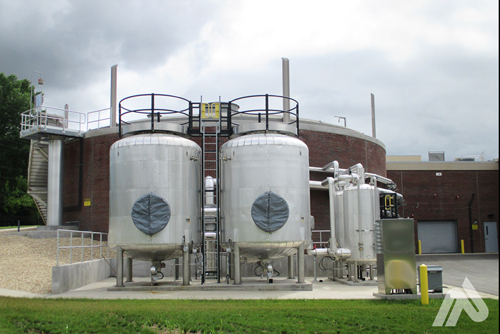

Hydrogen sulfide (H2S) is one of the most common — and most problematic — contaminants in biogas. Effective H2S treatment, sometimes called H2S scrubbing, is essential to protecting downstream equipment and meeting air quality and pipeline specifications.
Present in virtually every anaerobic digestion and landfill gas stream, H2S is corrosive and toxic. If left untreated, it will degrade downstream equipment, increase maintenance costs, and create compliance problems. Effective removal is critical to any biogas system.
Unison Solutions has designed and manufactured H2S removal and scrubbing systems for more than 25 years, serving wastewater treatment plants, landfills, agricultural digesters, and food processing facilities across the U.S. and Canada. We offer multiple removal technologies and media options, and our in-house engineering team will evaluate your specific biogas chemistry to recommend the right solution for your application.
Why H2S Removal Matters
Hydrogen sulfide causes problems at every stage of a biogas system.
- Equipment corrosion: H2S reacts with moisture to form sulfuric acid, aggressively corroding compressors, heat exchangers, engines, and piping. Even moderate H2S concentrations — in the hundreds of ppm range — will shorten equipment life significantly.
- SO2 emissions: When H2S-laden biogas is combusted, it produces sulfur dioxide (SO2), which is a regulated air pollutant. H2S removal is often required to meet air permit limits.
- Siloxane removal interference: H2S can compete with and reduce the effectiveness of siloxane removal media, making it important to address H2S first.
- Pipeline and RNG quality standards: Natural gas pipeline interconnection requirements set strict limits on H2S content. RNG producers must achieve consistent, reliable removal to meet these specifications.
- Worker safety: H2S is acutely toxic. At concentrations above 100 ppm, it can cause immediate collapse and death. OSHA and other regulatory bodies set strict exposure limits that biogas facility operators must manage.
H2S Concentrations Vary Widely by Source
H2S concentration can vary dramatically depending on the feedstock and digester type. A solution that works well for one application may be undersized or over-engineered for another.
- Wastewater treatment (municipal digesters): Typically 500–3,000 ppm H2S, though concentrations can spike with certain influent conditions or co-digestion of high-strength waste.
- Landfill gas: Generally lower H2S levels than digesters — often 50–200 ppm — but highly variable depending on waste composition and landfill age.
- Agricultural (dairy, swine): Can range from a few hundred to typically 3,000-5,000 ppm. High-sulfur feed supplements or co-digested materials can push concentrations significantly higher.
- Food and beverage processing: Highly variable; high-protein or sulfur-rich feedstocks (e.g., brewery waste, food processing residuals) can produce elevated H2S levels.
H2S Removal and Treatment Technologies: Matching the Solution to the Application
Unison Solutions offers multiple H2S removal approaches. Our engineering team evaluates each project individually — considering H2S concentration, gas flow rate, target outlet concentration, and end-use application — to recommend the most cost-effective solution.
Static Bed Media Systems (Fixed Bed Media Vessels)
Media systems are the most widely used approach for biogas H2S removal. This approach is commonly referred to as H2S scrubbing or a biogas scrubber system.
Biogas passes through a vessel containing a reactive or adsorptive media that captures and neutralizes H2S. Unison designs and fabricates custom ASME and non-ASME stainless steel vessels for static bed applications, sized to the specific H2S load and target outlet concentration of each project.
We offer a variety of media options for static bed systems, including iron oxide-based media and activated carbon products. Media selection depends on inlet H2S concentration, gas flow rate, and moisture content. Our team maintains a large inventory of media products for quick delivery, and we provide media replacement services as part of ongoing customer support.
In-Digester H2S Reduction
For applications where reducing H2S at the source is preferred, Unison offers an iron oxide-hydroxide-based reduction powder that is added directly to the anaerobic digester. The powder binds hydrogen sulfide within the digester before it enters the gas stream, providing a cost-effective, non-corrosive approach to H2S management — particularly well-suited for agricultural digesters and situations where upstream reduction can meaningfully reduce the burden on downstream treatment systems.
The Unison Approach: Engineered for Your Specific Biogas Chemistry
No two biogas streams are identical. H2S concentration, gas flow rate, moisture content, and the target end use all influence which H2S removal system is right for a given project. Unison’s in-house engineers and chemistry experts use biogas analysis data to specify the optimal technology and media combination.
Because we design, fabricate, assemble, and factory-test all systems at our Dubuque, Iowa facility, we maintain tight control over quality and performance. Custom vessel sizes, materials, and configurations are standard — not exceptions. And because we stock a large inventory of media products, customers can count on fast delivery when it’s time for media replacement.
Get a Custom H2S Removal Solution
Tell us about your biogas source, flow rate, and H2S concentration, and we will recommend the right removal approach for your application. Unison’s engineers are ready to help you protect your equipment, meet air permit requirements, and achieve your pipeline or RNG quality targets.
FREQUENTLY ASKED QUESTIONS (FAQs)
It depends on the end use. IC engines and boilers typically tolerate H2S up to a few hundred ppm before corrosion becomes a significant maintenance concern, though manufacturers’ specifications vary, especially if an exhaust catalyst is required. Pipeline injection requires outlet H2S in the low single-digit ppm range or lower. RNG vehicle fuel applications have similarly strict limits. Your Unison engineer will size the system to your specific target outlet concentration.
H2S needs to be addressed upstream of siloxane removal. Elevated H2S levels can reduce the capacity and effectiveness of siloxane removal media, increasing operating costs and reducing media life. Many Unison systems are designed to treat H2S and siloxanes in an integrated sequence to optimize both.
Media life depends on the inlet H2S concentration, gas flow rate, and media type. Unison’s team can estimate media replacement intervals based on your biogas analysis data. We also offer maintenance contracts and media replacement services to help facilities manage this proactively rather than reactively.
Yes. Unison designs standalone H2S removal systems that can be integrated into existing biogas conditioning trains. We also provide media and support services for H2S removal systems supplied by other manufacturers.